3 min read

Peak paranoia is real. Here’s how to use it.

Peak paranoia is real. Here’s how to use it.
4:21

Spoiler: this is pattern recognition, not panic.

That unease is the warning before the crash.

"Why is the release delayed again?" "We had to roll back the last one." "The CIO's wife couldn't check out last night."

If these sound familiar, you're not alone.

Retail IT leaders are rightly on edge. Every peak season now arrives more volatile than the last, and also more profitable, if you can handle it. We're seeing stacking pressure from:

  • New tooling shoved into legacy estates.
  • Shadow AI and ungoverned AI adoption grafted onto brittle platforms.
  • SIs pushing through replatforms with no time to validate stability.

And then there are the cautionary tales:

  • M&S's eComm downtime, including a separate incident where a Cloudflare outage took its site down alongside AllSaints and Zalando, with none of them at fault for their own code.
  • Amazon's own AI tooling triggering four high-severity retail site incidents in a single week, including a six-hour checkout blackout.
  • A global Shopify outage that took down checkout, admin, storefronts and POS at once, and exposed just how few merchants have any uptime guarantee at all.

Meanwhile, retailers keep gearing up for their biggest peak yet, armed with full-scale load testing, robust automation, QA...

Call it preparation, not paranoia.

Peak is a trap… but also an opportunity. Here's what's changing.

Peak used to mean pressure. Now it means unpredictability.

  • Traffic surges are the easy part. It's inconsistent data, untested integrations, and sprawling microservices that will break you.
  • Loyalty is low. Tolerance is lower. One slip and your customers won't come back.
  • New tech is being bolted on (AI, loyalty engines, MACH services) without foundational QA.
  • Most retailers are still betting on last year's data. But last year's success doesn't mean this year's stack is stable.

Questions retail tech leaders must ask (but often don't)

Let's get brutally honest. If you can't answer these, your peak is already in danger:

  • What part of your stack will fail first, and who's on the hook when it does? (Remember, it's not your tech provider's lost sale, it's yours.)
  • Have you validated new systems under actual peak-like traffic, or are you crossing your fingers?
  • What's changed in your environment since last peak, and have you retested those flows?
  • Are your third-party integrations, APIs, and loyalty tools tested at scale, or just "assumed fine"?
  • If the rollback plan had to happen tonight, could you execute it in under 30 minutes?

The hidden gaps that are hard to spot (until it's too late)

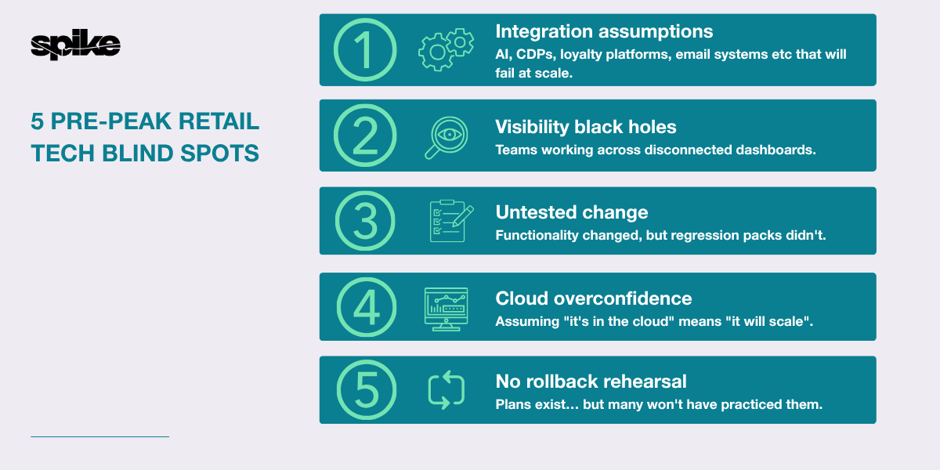
Spike's transformation work reveals the same blind spots in almost every pre-peak audit. Here are the five most critical:

peak-retail-tech-blindspots

  1. Integration assumptions: AI, CDPs, loyalty platforms, email systems and more that will fail at scale.
  2. Visibility black holes: teams working across disconnected dashboards.
  3. Untested change: functionality changed, but regression packs didn't.
  4. Cloud overconfidence: assuming “it's in the cloud” means “it will scale”.
  5. No rollback rehearsal: plans exist, but many won't have practised them.

From paranoia to preparedness: your peak survival protocol

Feeling uneasy? Good. That's your instincts telling you to act.

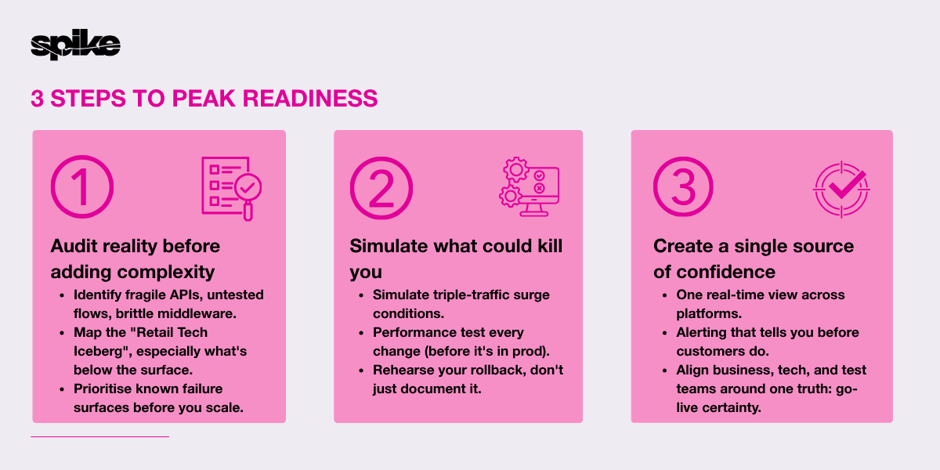
But knowing something's off isn't the same as preparing for it. You need a framework to de-risk before it's too late. Here is our 3-step peak survival protocol:

peak-readiness-three-steps

Step 1: Audit reality before adding complexity

  • Identify fragile APIs, untested flows and brittle middleware.
  • Map the “Retail Tech Iceberg”, especially what's below the surface.
  • Prioritise known failure surfaces before you scale.

Step 2: Simulate what could kill you

  • Simulate triple-traffic surge conditions.
  • Performance test every change before it's in production.
  • Rehearse your rollback, don't just document it.

Step 3: Create a single source of confidence

  • One real-time view across platforms.
  • Alerting that tells you before customers do.
  • Align business, tech and test teams around one truth: go-live certainty.

The clock is already ticking

Paranoia only becomes leadership when you act on it. Most retailers won't prepare until it's too late. You don't need another SI and you don't need another dashboard. You just need to harness your paranoia and turn it into action. If time is short, start with the eight Must activities in The Peak Survival Guide. And if you want support, see how Spike helps retailers scale for peaks.

Turn paranoia into a plan

The Peak Survival Guide breaks down exactly what to fix first, using a Must/Should/Could framework across the five risk areas that take retail platforms down at peak.

Related posts

Evidence, not optimism: introducing The Peak Survival Guide

Evidence, not optimism: introducing The Peak Survival Guide

Spike's Peak Survival Guide gives retail tech leaders a Must, Should, Could framework across five peak trading risk areas. Free download.

Read More
Cloud doesn't equal confidence: Two big traps to avoid with cloud in retail tech.

Cloud doesn't equal confidence: Two big traps to avoid with cloud in retail tech.

Cloud migration has become a badge of honour over the past decade. The uncomfortable truth: just because it’s cloud-based doesn’t mean it’s...

Read More
Retailers - Prepare your software for peak seasons!

Retailers - Prepare your software for peak seasons!

As we move towards the end of 2020, t’s never too late to develop a plan of action now and prepare your software for peak seasons.

Read More