The UAT change champion model in practice: How to set it up and what it delivers
Learn the importance of UAT change champions, how to implement them effectively, and the significant benefits they bring to large retail tech...
4 min read

In the first article in this series, we looked at why UAT fails and what good looks like at a structural level. This article goes deeper on one of the most effective ways to change the model: running UAT in functional slices, rather than waiting for a single big-bang phase at the end of the programme.
There is a version of UAT that nearly every large retail technology programme defaults to: All the development work completes; all the testing phases run; and then at the end, the business comes in and accepts everything at once.
It sounds logical, but in practice, it's one of the most common ways to turn UAT into a crisis.
By the time users arrive, the programme is typically behind schedule and there's pressure to get through acceptance quickly. The system has never been seen by the people who are now being asked to sign it off and if something goes wrong (and it usually does) there's no time left to fix it before the go-live date.
The alternative is not complicated, but it requires discipline.
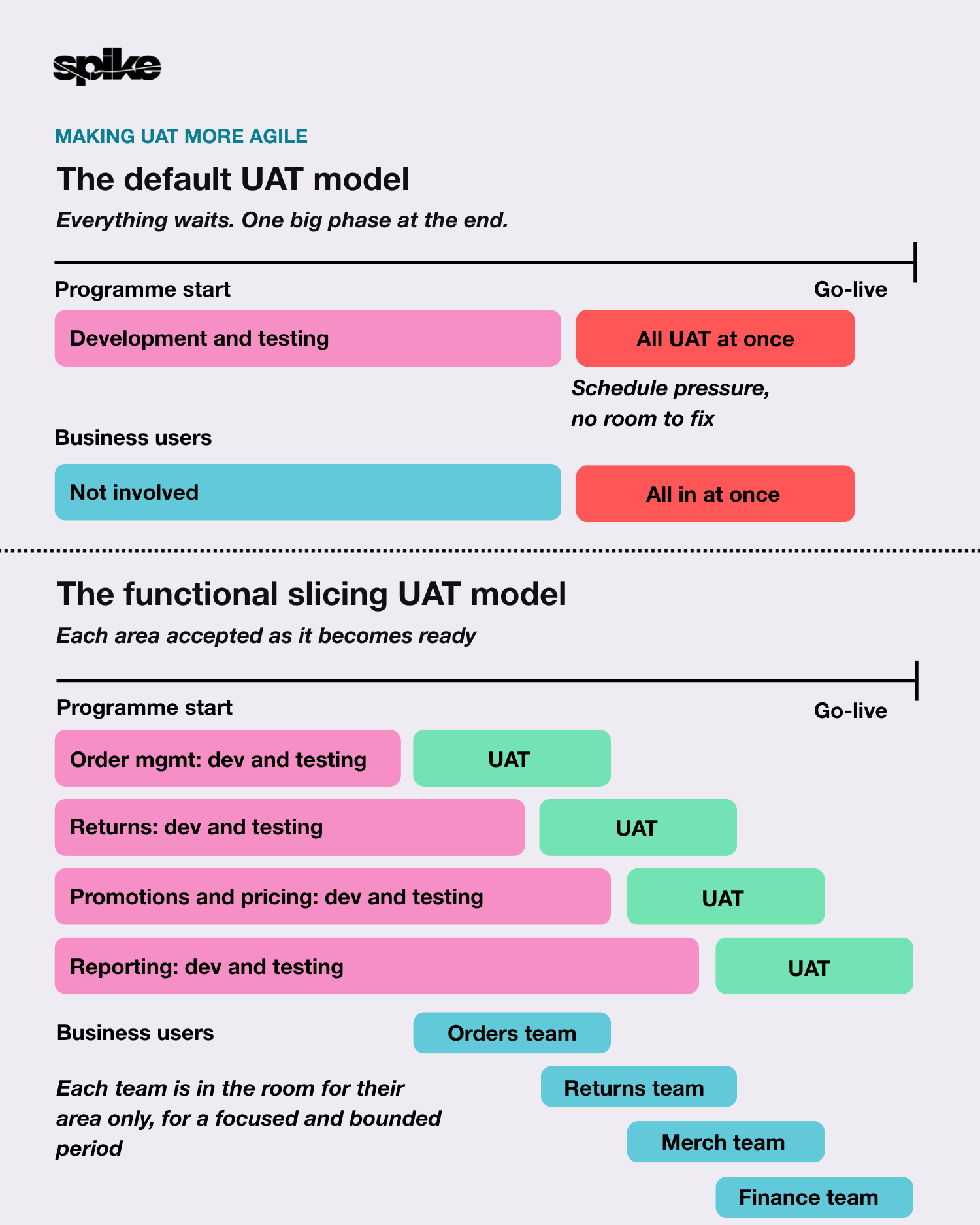
Rather than treating UAT as a single phase that follows everything else, you identify which functional areas are ready for acceptance and bring the relevant users in to accept those areas, while development and testing continues on others.
For example, order management is ready and proven so you bring in the order management team. The returns process is still in system testing so that team stays out until it is ready to be tested.
This isn't parallel running in the problematic sense. And it isn't dropping users into an unstable system because the programme has run out of time. It is planned, sequenced acceptance, with a clear and enforced boundary around what is and isn't ready.
The distinction matters. A programme that stages UAT based on genuine readiness is fundamentally different from one that launches everyone at a half-finished system because the go-live date is set in stone.
We believe the business case for functional slicing is very strong.
Firstly, it spreads the business impact. Rather than pulling key colleagues out of the business at the same time, you stagger their involvement. The business keeps running and the people in UAT are focused on their specific area rather than trying to absorb a whole new system at once.
Secondly, it gives you an earlier signal. If the order management journey has a fundamental problem, you find out during order management UAT, not during a combined acceptance phase where everything is in flight at once. That earlier signal gives the programme time to respond.
Finally, it reduces the pressure that causes poor decisions. The big-bang approach creates a deadline that the whole programme is racing towards. When that deadline arrives and UAT is not going well, the conversation quickly becomes about what can be descoped or deferred rather than what actually needs to be fixed. Functional slicing distributes that pressure across the programme, rather than concentrating it at the end.
On a large retail technology programme with multiple platforms and workstreams, the sequencing question becomes more complex. Some functional areas have dependencies. You can't accept the returns process until order management is in, because returns depend on orders existing. Promotions may depend on pricing. Reporting may depend on almost everything else.
Mapping those dependencies early, as part of the programme's test strategy rather than as a UAT planning exercise, is what makes functional slicing work in practice. It is the same principle that applies to testing before coding: the earlier you think about what needs to be proven and in what order, the better placed you are to run a programme that doesn't collapse under its own weight at the end.
The sequencing also informs how you resource UAT. If order management acceptance runs in weeks eight and nine, and returns acceptance runs in weeks ten and eleven, you can plan business user availability accordingly. People are out of the business for focused, bounded periods rather than for a single extended block. That is a materially better outcome for the business, and it makes it easier to get senior, experienced users into the room rather than whoever is available.
Next in the series: The change champion model in practice: how to set it up and what it delivers.
Sign up to our monthly ctrl freaks emails to make sure you don't miss it.




Learn the importance of UAT change champions, how to implement them effectively, and the significant benefits they bring to large retail tech...

Explore why UAT often fails in retail tech programmes. Discover how proper preparation, user involvement, and effective testing can transform the...

Explore the critical conversations from Retail Jam 2026 on AI, trust, and quality in retail technology. Learn how businesses are navigating new...

Spike's Graded Test Approach makes sure your retail testing strategy has the right scrutiny and resilience. Download the free guide.

Transition to continuous delivery in retail tech by structured testing, gradual cadence increase, clear ownership. Learn how Spike helps retailers do...

Retailers rarely fail because they lack technology. Retailers fail because they don't know how to make technology work together. How can you simplify?